The Wood Wide Web
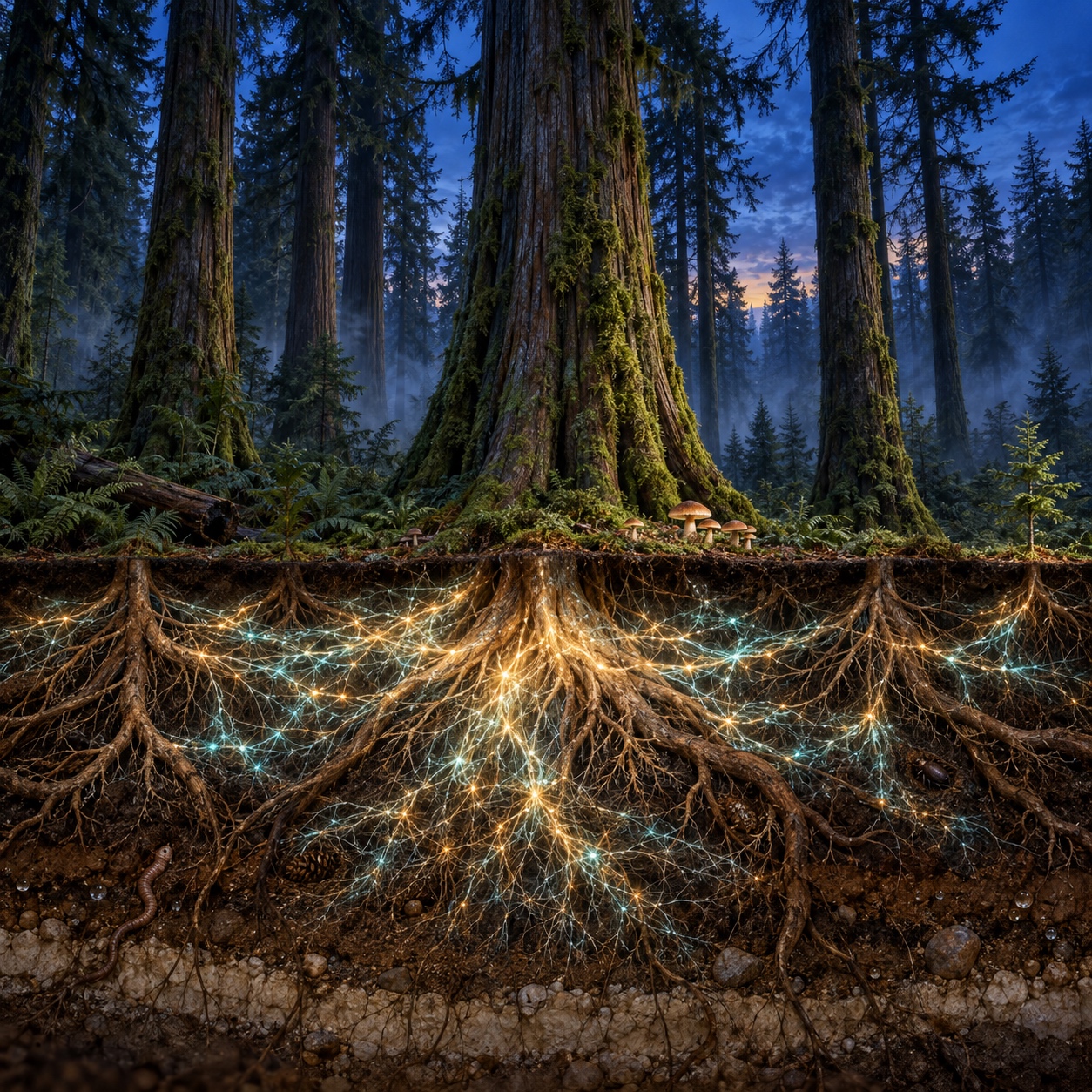
The top half of this picture is a forest you could walk into. Tall firs fade into the mist, ferns cover the ground, and a fallen log rots slowly on the left. The sky has gone indigo with one last warm streak low behind the trees. Nothing up there looks unusual. It is the kind of quiet evening that makes people lower their voices on a trail.
Then the ground has been sliced away, and the quiet turns out to be busy.
Under the soil line every tree has its root system on display, and those roots are not separate. A web of fine threads runs between them, lit in cyan and amber, thickest around the giant cedar in the middle and thinning as it reaches the younger trees at the edges. The glow is artistic license. What it stands for is real, though. Most trees grow in partnership with mycorrhizal fungi, which wrap around or into their roots and trade water and minerals from the soil for sugars the tree makes in its leaves. Those fungal threads can connect one tree to the next. Researchers still disagree about how much the trees actually share through those links. The network itself is not in doubt.
The picture does not ask you to settle that argument. It gives you a way to see underground, and it rewards slow looking. A few mushrooms have come up right above the densest part of the web. Mushrooms are the fruiting bodies of fungi, so their placement makes sense. An earthworm works its way through the lower left. A beetle rests on a root to the right. A pine cone is buried in the dark upper soil, and below that the layers shift from black humus to brown loam to a pale band of stones and clay.
The image works because of the cut. A painting of a forest at dusk is pleasant. A painting of a glowing root network would look like a screensaver. With both halves in one frame, joined by the cedar's trunk running straight through the line, the everyday view and the hidden one sit side by side. Most of what keeps that forest standing is the half you would never see from the trail.